Showing posts with label Latin (and other languages). Show all posts

Wednesday, January 20, 2016

French for Children Review

Pin It
This is a guest post from Carol over at Journey and Destination and is sponsored by Classical Academic Press.

Moozle, my ten year old, has been learning French informally for a few years, mostly by listening to French folksongs and copying French phrases into her notebook. This has worked quite well up until recently. Her pronunciation sounds natural, and she speaks the French she knows with confidence, but I knew that it was time she started a more formal program. This was easier said than done.

We've had a checkered history in the foreign language department in our home, but it wasn't through lack of resources. I don't like to think about how much money has gone into buying curricula that sounded so promising but in reality just didn't work for us. Some of these purchases were not thorough enough, others were better suited to adults or older independent students, and some were just plain old boring.

I was reluctant to make any more expenditures after being disappointed with what I'd already purchased, but then I saw that Classical Academic Press (CAP) was about to publish French for Children. I'd been receiving their monthly eNewsletter, Insights, for about a year and liked what I'd read:

Our motto “Classical Subjects Creatively Taught,” describes the essence of all that we publish. We seek to produce classical curricula and media with a clear design and structure, incremental and systematic instruction, all with a touch of delight, creativity, and flair. 

This is what I was after for my daughter...structure, but with delight, creativity & flair.

Classical Academic Press kindly gave me a free copy of this curriculum for review purposes, and here are my considered thoughts after putting it to use in our home school. 


A General Overview of French for Children


French for Children, Primer A is the first text in a three year series for elementary students. It is recommended for grade 4 and up and has a similar structure to CAP's Latin series for children.

There are 17 Chapters and a choice of weekly schedules to allow the course to be completed in either half a year or a full academic year of thirty weeks. 

French for Children takes a creative immersion-type approach which uses dialogue, translation, chants, vocabulary, dictation, grammar, and quizzes.

It is well laid out, uncluttered, and the text is easy on the eyes.


What the program includes: 


  • French for Children: Primer A - Student text, 245 pages.

  • French for Children: Primer A - Answer Key

  • French for Children: Primer A - 7 DVD Set & Chant CD


What French for Children Looks Like in Practice


This will vary a little depending on whether you are covering the material over a half or full academic year. I recommend watching the first DVD to get an overview of the course before you start. It takes you through the structure of the lessons and explains the various components.

A 15 page section called the 'Pronunciation Wizard' is located at the beginning of the Student Text and as the student progresses through the course they are instructed to refer back to various sections to read explanations and listen to the relevant audio track. 

This is how I've structured the chapters:

Listen to the Dialogue - A story is woven together throughout the course & Moozle follows along while listening to the audio. This is partly in French, partly in English and introduces new vocabulary. She gets an idea of what the new words mean from the context and tells me what she thinks is happening. The dialogue translation is in the back of the Student Text.

Chant - phrases & sets of words to help with pronunciation. 'Je parle, tu parles, il/elle parle.' These are on the CD and Moozle repeats them aloud after listening.

Vocabulary - new words (about ten per chapter). These are meant to be memorized & students may make their own flashcards for this purpose. I've been getting Moozle to write them down in her French notebook.

Video - these are about 45min to an hour long each, so there is a lot of information. Sometimes I divide them over two days or go over parts if I think it necessary. The DVD's are very helpful for a parent who doesn't have a knowledge of French, or needs to brush up on what they did years ago, and are an integral part of the course.

Grammar - this course emphasizes grammar but also gives grammatical instruction in an incremental way so it's suitable for a child who may not have done much grammar previously, but is ready for the concepts e.g. at a grade 4 level.

Worksheets & Quizzes - these include translation exercises, completing charts, verb forms, grammar exercises etc.

La dictée - Dictation! In France, and several other countries (Switzerland, Belgium, Poland, and Canada, for example), the dictations are structured contests, similar to spelling bees. This is something I hadn't attempted with Moozle because my French pronunciation wasn't to be trusted, but the dictation selections are on the CD and I just have to press a button. It's the same as standard dictation except, of course, the sentences are in French: 'Elle travaille beaucoup.'


Final Thoughts About French for Children


I think this is a very thorough curriculum; well-structured and methodical, while at the same time including enough variety to keep it engaging and interesting.

Personally, I think it is in keeping with the Charlotte Mason approach if it is used, as CAP recommends, for grade 4 and up, as this is generally when the study of grammar is introduced in a CM education.

The grammar content in Primer A starts with subjects and verbs and continues to add in other concepts such as infinitives, verb conjugation, tense and noun gender.

After a few years of getting ears and tongue accustomed to French words mostly through the medium of folksongs, French for Children is an ideal next step for us.

I think it would also be a good starting point for a student who hasn't had any prior experience with the French language because of its multifaceted approach.

The only thing I'd add is listening to French folksongs on a regular basis. We are continuing to do this and I've included a playlist of some that we have used below.


French for  Children Freebies and Giveaway!


Classical Academic Press has a very generous 64 page pdf of the French for Children: Primer A Student Text that you may download and try out. There is also a free audio MP3 sample and the video below is the first chapter of the course (about 45 mins long). You can learn more, purchase the curriculum, or download the  freebies on the French for Children webpage.


Classical Academic Press is giving away two French for Children: Primer A bundles for USA residents. Enter via the Raffelcopter form below!

A 20% discount off of all CAP French products with the discount code FFC2016 is also available through to January 31st for anyone to use.

It is also valid on the already discounted French for Children full-program (the bundle). If a person in the USA orders from CAP with the 20% off and then wins the giveaway, they will be refunded.

Giveaway ends at midnight on January 31st. Winners will be contacted by email. Winners that do not respond by the deadline given in the winners’ email will be replaced by random drawing.

 photo SubscribeButton_zpsdc17ac56.png

Congratulations to winners Laura L. and Sharron C.

Thursday, July 16, 2015

Delighting in Latin - A Song School Latin 2 Review

Pin It
                                   This post is sponsored by Classical Academic Press.

One of my favorite things this past year has been learning Latin.  I knew nothing about Latin before we started last year, so I am learning right along with my children. What I love the most is learning how much of our English language is influenced by Latin. I am continually amazed at how many of our words are derived in some way from Latin words.


English just makes so much more sense when you know Latin.  I can't believe that I can already tell that after only doing 2 years of very basic learning...taught by a monkey =)

Here are a couple of examples of words that have me delighting in learning Latin:

Contradict -

contra = against
dico = I speak


Transport -

trans = across
porto = I carry


Do you love that too, or am I just odd?  I think I learn things better when I can know the "why" behind them, so when I can see our words broken down like that, it leaves me amazed!

In those examples, I probably should have given the infinitive (to speak, to carry), but I'm still learning, so I did the best I could =)  I'm sure you got the idea despite my insufficiency.


Using Song School Latin 2


Last year we used Song School Latin 1, so this year we moved right along to Song School Latin 2.  SSL1 focuses mostly on fun, familiar words and is a wonderful way to introduce a child to Latin.  When I got to flip through SSL2, I was amazed at how much longer the book was, and how much more content it covered.  It still has all the fun of SSL1, but adds much more grammar.


Each chapter includes new vocab words, a fun song, a grammar lesson, worksheets, and activities.  If you want a better look (or listen!) at these components, the Classical Academic Press website has samples of everything for you.


I am not making my son memorize all of the words and especially not all of the conjugations and declensions.  Of course you could do that, but I am looking at this program as a first taste of learning Latin and I want my kids to just be excited about it.  (We go through every chapter and practice everything, I'm just not testing him on the material.)

So far, it is working =)  As I sit here typing this, my son actually asked me if I could play the Monkey Match game with him.  I told him to wait just a few minutes, so now he is playing by himself on the other side of the room and humming one of the Latin songs.  No joke!


My kids both are learning so much and think it is so neat to see what derivatives we get from Latin.  When we are out at the store and hear people talking another language, I always think it is so funny when my 5 year old daughter says "Oh, they are probably speaking Latin."  I love that Latin is just a normal part of our life (not that we are any good at it yet!)

Another part of the curriculum that you can get is the DVD.  That is the kind of 'extra' that I typically don't get.  I figure if I'm teaching the lesson already, why do I need someone else to teach it to my kids again.  In this case, I would have been making a big mistake!  The SSL2 DVD is very much worth it for so many reasons.


  • It helps you hear the pronunciation clearly, if you are not already a Latin pro
  • It gives your child another exposure to the material, since it is something completely new
  • It gives Latin an element of fun, if they are not as excited about the derivatives as I am =)
  • It helps your child learn through multiple senses

The DVD lessons are short and sweet.  Each lesson has a few parts: new vocabulary, derivatives, grammar lesson, and a fun cartoon at the end.  Can I make a confession?  I've never actually seen the DVD.  Eek!  I feel bad saying that!  I may have never seen them, but I have heard them many, many times.  We have a built in DVD player in our minivan and I really don't appreciate having it there, but the one thing I will let my kids occasionally watch are these Latin DVDs.  I really enjoy listening to them.  The voices are pleasing, the derivatives are fascinating, and the cartoon at the end is really funny.  Here is a sample (so I guess now I can say that I've seen it!)


Song School Latin Giveaway


Here comes the fun part!  If you are looking for a Latin program to use with your lower elementary students next year, you can enter to win the entire Song School Latin 2 curriculum!  Classical Academic Press has graciously offered to give one of my readers the complete SSL2 program which includes:

  • Song School Latin 2 Student Edition
  • Song School Latin 2 Teacher's Edition
  • Latin Monkey Match 2 Flashcard Game
  • Song School Latin 2 DVD Set


If you don't win, or if you are in need of a different Latin curriculum, you can use code: LLH20 to get 20% off of any Latin curriculum (included the already discounted bundles!) at Classical Academic Press until the end of the month (7-31-15).


a Rafflecopter giveaway
 photo SubscribeButton_zpsdc17ac56.png

Monday, March 9, 2015

Memorizing John 1 in Latin - Helpful Resources

Pin It
This post contains an affiliate link to a product that I use.

My children and I have been memorizing John 1:1-7 in both English and Latin as part of our learning this year.  The English part was not so hard, but Latin is a bit more of a challenge!  I am so impressed at how well my children have picked up on it, and it is so neat to hear them speaking in Latin.

We have found a few resources to be helpful in our learning and I wanted to share them with you.


Learning John 1 Through Song


Learning through song is always so helpful.  Our knowledge shouldn't stay in song form, but it is very effective for initially memorizing information.

Here is the song that we have used to learn John 1.  There are others out there, so search on youtube or Google if you don't like this tune.


John 1 Scripture Folder


Pam (from ED Snapshots) has created a great resource for helping kids to learn John 1:1-7 in Latin.  This file folder puzzle has 3 different levels for your child to practice what they have learned.  Children review by putting the words from the verse in the right order.  I love the version where they sit the words into the right sized boxes.  It is just enough help to encourage them on their way.

My kids did this last week and it was a good challenge.  My favorite part was hearing them sing the song over and over to themselves in order to figure out which word to look for next.  My son only did a few lines of the puzzle, but he must have sung the son 20 times!  What great practice!

If you are learning John 1 like we are, make sure to check out this John 1 Scripture Folder.


Listening to a Beautiful Presentation


This is a video of from Classical Academic Press of Christopher Perrin reading the whole chapter of John 1 in Latin.  It is a beautiful presentation.  Take a minute to listen.  You'll be glad you did!


Are you learning John 1 in Latin?  

What resources have you found helpful?

Do you have any memorization tips to share?


 photo SubscribeButton_zpsdc17ac56.png

Thursday, September 11, 2014

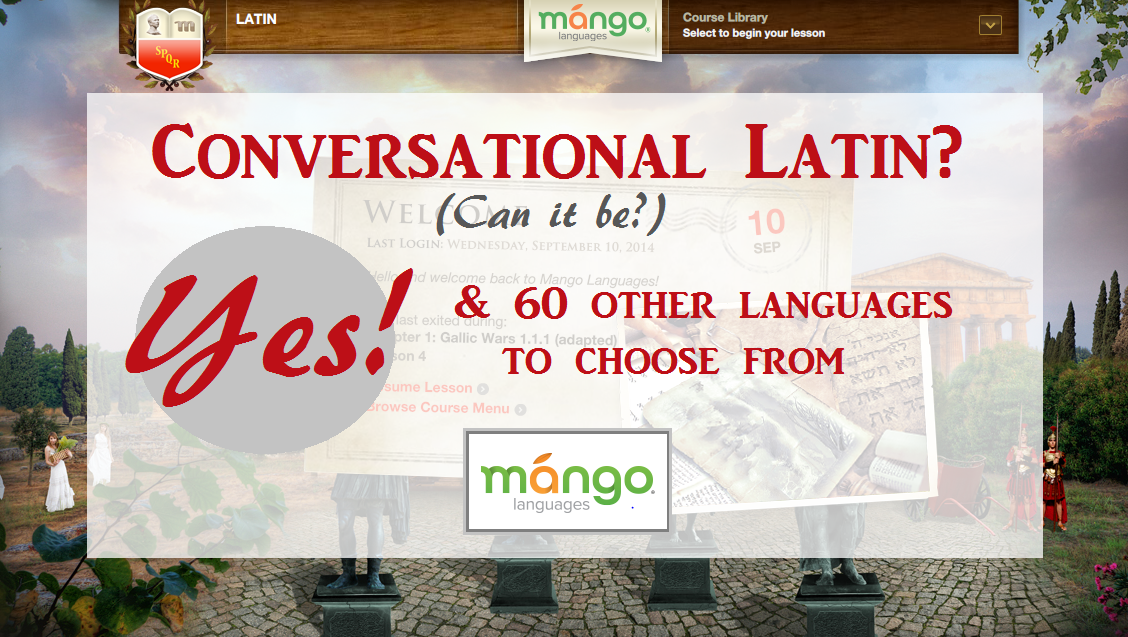
Conversational Latin? Yes, with Mango Languages!

Mango Language Homeschool e-Learning Software
Pin It
I was provided with this program to review and was compensated for my time.  All opinions are my own!

We are classical homeschoolers over here, and I know many of you are too.  That means that many of us are teaching Latin to our kids.  The biggest problem with learning Latin is that it is not very easy to get a feel for how the language sounds.  With other languages, you can watch a movie, visit the country it is spoken it, or even just hear it spoken in the grocery store, but with Latin being a dead language you can't do that.

When I heard about Mango Languages, I was excited because it is a program that teaches over 60 languages by having students listen to the spoken language and repeat it back.   At first, I figured that the dead languages wouldn't be a part of the program, but I was thrilled to find Latin, Greek, and even Hebrew!


Mango Languages for Homeschool


Mango Language Homeschool e-Learning Software

Mango Languages lets you be as hands on or hands off as you want to be.  Personally, I sat with my son each time he did a lesson because he is only 6 years old, but if you have older children they could easily do the program themselves, freeing you up from having to teach a subject!  My son really enjoyed doing each lesson, saying the words and combining them into sentences.

First, you pick your language.  Like I said, there are over 60 languages available and within each language there are even different course options and dialects to choose from.  I think that it is really neat that you don't have to stick to one language.  While it would be smart to focus on one, you are free to browse other languages.  What a neat way to familiarize yourself with what is out there.

Then you get started on your lesson!  Some courses have pre-tests and placement tests (Latin did not, but I think the more common languages do) to ensure you are doing the right lesson, and curriculum outlines for you, the parent.

Each lesson is guided by a voice that reads slides and instructs the student what to do.  I love how simple it is to follow.  At first I thought I was missing something because I didn't really need to navigate to start the second lesson, but then I realized that it just knew where I left off and took me right there.  It even keeps track of how many minutes you child has spent on their language lessons.  It's nice to see that, as visual proof that they have been working hard!


Mango Language Homeschool e-Learning Software
 

How Does Mango Help you Learn Another Language?


Mango Languages teaches in a really nice, no pressure, confidence building way.  For our Latin lessons, the speaker would read a sentence and we would try to read it back.  Then she would break apart each word or phrase and explain what it was and we would repeat it again.  Sometimes she would have us guess how to say something based on previous rules we had learned.  If we weren't sure, we would guess and then click the button to hear the right answer.  If we thought we knew it, but needed more time, we would just add time to the clock!  If we needed to hear a pronunciation again, no problem, just click the replay button.  It is completely your pace.

From time to time, a mini grammar lesson was interjected.  These were helpful and answered just the questions that were starting to come up in my mind.  There are also cultural incites, given at just the right moment.

Mango Language Homeschool e-Learning Software

In Latin, the word order in a sentence can often be mixed around.  That can make it confusing to figure out which word is which.  Mango solves this problem by color coding the words they show you.  If there is an English and a Latin sentence on the same screen, each word will be in a different color and the corresponding word in the other language will have the same color.  Neat!  Plus, if you hover over a word, it will show your the way to pronounce it and even give you the option to have it spoken.

I give it an A+ for being intuitive and easy to use.

Here is a little peek at how the lessons go.  My son was controlling the mouse, so forgive the slow navigation =)


Who should try Mango Languages?


Have I mentioned that you can try Mango Languages for free?!   You can also use discount code: HS5PM to get $5 off of your monthly rate.  Or if you are really lucky you can win a Kindle Fire with Mango already loaded onto it! (Enter the giveaway at the end of the post.)

So who should take advantage of these offers?

  • Parents, Mango is perfect for you if you want to understand the language your child is studying on their own.  It is also the perfect way to familiarize yourself with a language that you plan on teaching your child.

  •  Teenagers who want to study a language on their own, or maybe even try out a few!

  •  Moms who want one subject to be taken off of their plate, or who just don't feel qualified to teach a foreign language.

  • Younger students who want to hear what the fruit of their labor can accomplish and who want to be able to say sentences right away (not just random vocab).

  • Families with multiple students who want to learn different languages.  Mango has it all in one place and you can register up to 6 kids in their homeschool program!
 
  • Anyone who wants to learn ancient Greek or Hebrew in order to study the Bible more deeply.

  • Classical homeschoolers who want to be able to hear the dead languages spoken and increase their ability to read original works.

  • Anyone who is planning on traveling to a foreign country.  Mango has it all, including mini courses designed for specific purposes like medical terminology or food.

Definitely take advantage of the free trial or jump right in and use the discount code (HS5PM).  Mango Languages would make a great supplement to what you are already using, or would perfectly fill the language gap in your homeschool curriculum.


Keep up with Mango Language here:


Mango Languages Kindle Fire Giveaway


 photo SubscribeButton_zpsdc17ac56.png

Friday, February 7, 2014

Teaching Languages - Teaching the Trivium Ch. 5

Pin It
This post contains an affiliate link to the book that we are going through.

Welcome to another week of the Teaching the Trivium book club!  I am so excited to read and discuss this book along with you.  I loved the discussion last week and would love to hear from more of you!  Today we talk about languages.


Chapter 5 - Teaching Lauguages


I am going to come right out and say that this was a difficult chapter.  My kids are little, and while we have begun basic Latin (we love Song School Latin), this chapter goes deep into the 'whys' and 'hows' of teaching classical languages.  Let's start of  with a question for you!


What language(s) are you teaching your children?  

Do you value teaching the classical languages over modern languages?  


An Argument for Teaching the Classical Languages


This first section of the chapter talks generally about the benefits of learning these dead languages, and then takes Latin, Greek, and Hebrew specifically and defends why the study of each is worthwhile.

I find the reasons for learning Latin compelling.  As a Christian, I think that learning Greek would be extremely helpful.  Hebrew just sounds painful ;) 

I underlined a lot of things in this chapter.  Many of them because I know that I will want to revisit them as my children enter this stage more.  Here are some of the quotes that  I found really interesting.

As the knowledge of the Biblical languages diminished among the common people, a darkness crept over professed Christianity.  The people became more and more dependent upon religious professionals.   pg. 108

Wow.  That is very interesting to me!  I have never even considered learning Greek for myself, for the sake of understanding the Scriptures.  I've just always depended on trustworthy translations like most Christians do.  The Bluedorns also mention that many seminaries do not even require the study of Greek and Hebrew anymore.  If that is true, it is shocking to me.  I don't know how well versed they are, but I know that my pastors had to learn Greek.  (I'm not certain about Hebrew).


If you are a Christian, does your pastor know Greek and Hebrew?  Does it matter to you if they do or not?


Only a century ago, no seminary in the United States even offered a course in Greek.  Students were expected to have mastered Greek before they entered seminary.

Wow!  Fascinating again!  Can you imagine if that sort of knowledge was expected in this day and age?  Most kids graduating high school can barley even handle our own language, let alone mastering another language (and a classical one at at that!)

Most classical educators expect their students to learn Latin.  I think the benefits are most obvious for that language, though if you are a Christian, the others become important as well.  Here are the reasons that the Bluedorns give for learning Latin (if you are a classical homeschooler, these reasons will be familiar to you):

  1. Latin is basic to English - much of our vocab is derived from Latin in one way or another
  2. Latin is a springboard for mastering other inflected languages - if you want to learn a modern language, Latin will make it much easier for you!
  3. The study of Latin sharpens the mental process
  4. Everything in a culture is embedded in its language
  5. Technical language is in Latin - medical/scientific/legal/etc.
  6. Latin is also valuable for further studies in all disciplines
  7. Latin is useful in English

A General Course of Study


The last part of the chapter is devoted to how exactly to teach these dead languages.  There are lots of charts and examples.  Honestly we are just not there yet in my family.  I underlined a lot of things to come back to in a few years and I learned a lot of thing I didn't know that I didn't know =)  What about you?


How do you teach the classical languages to your children?  

What resources have you used?  

What resources have you loved?


Leave comments here on the blog post, or share about it on social media (#ClassicalMamasRead).  I'll be sharing too, so follow me on facebook, twitter, or google+ and we can chat about it there as well!  Don't forget, if you want to share your thoughts about Teaching the Trivium on your own blog, link it up below so we can all come and visit!


Next week we will be talking about chapter six of Teaching the Trivium.  If you haven't gotten your own copy yet, make sure you check your library or order one soon so you can be ready for next time!  Also, this is a 600+ page book, so I am only touching on certain points of each chapter.  There is so much great information that I am not covering, so if this discussion interests you, you are going to want to make sure to pick up your own copy so you can read more!


Classical Mamas Read Link-Up


Did you write about Teaching the Trivium on your blog?  Have you been reading and blogging about another book (for you, not a children's book)?  Do you have a book club going on at your blog (once again, not for a children's book)?  I'd love for you link up here so we can all be encouraged by each other and maybe find another great book to read!

I think I'm going to keep this link-up ongoing since there aren't going to be a huge number of posts and then anyone new will be able to be encouraged by the other book reading ideas and discussions.  If the number of posts gets too large, I will fix it.

Please note, all posts must be on topic (about a book you are reading) and appropriate (think family friendly).


 photo SubscribeButton_zpsdc17ac56.png

Related Posts Plugin for WordPress, Blogger...